Total Pageviews

Tuesday, February 3, 2015

Sxk TVR color mutants 1/5/15 28 days post spawn

Color mutants SXK TVR 28 days post spawn.

Monday, February 2, 2015

SXK 1/5/15 28 days post spawn

From a full moon spawn and a 1 mm embryo to 28 days later and 1.25 inches of Ranchu.


Thursday, January 29, 2015

The goldfish bowl 2

And we wonder why goldfish are continually subjected to these less than ideal housing by new keepers. 


Monday, January 26, 2015

SXK TVR BBR 21 days post spawn eating bloodworms

Spawned 1/5/15
Currently 21 days post spawn


Tuesday, January 20, 2015

SXK Top view Ranchu color mutant 1/5/15 spawn

This is the first Ranchu color mutant I've found in red red/white metallic top view Ranchu. Seems to have a bluish color and a reddish head. 

Thursday, January 8, 2015

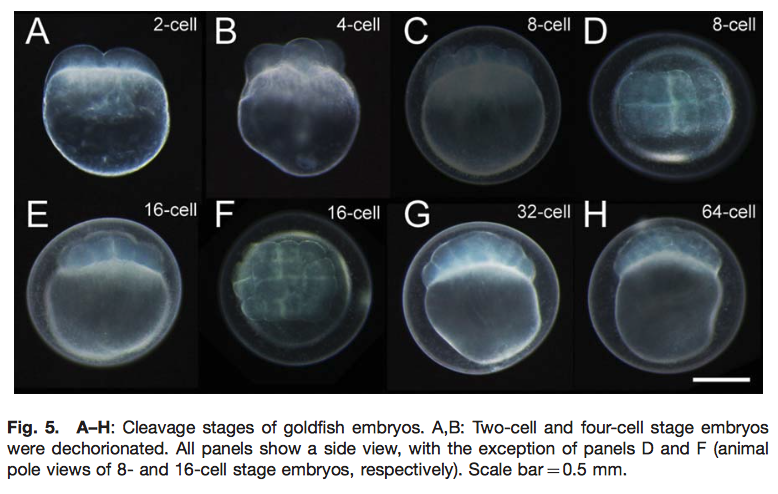
Embryonic Development of Goldfish


Embryonic Development of Goldfish (Carassius auratus): A Model for the Study of Evolutionary Change in Developmental Mechanisms by Artificial Selection

Background: Highly divergent morphology among the different goldfish strains (Carassius auratus) may make it a suitable model for investigating how artificial selection has altered developmental mechanisms. Here we describe the embryological development of the common goldfish (the single fin Wakin), which retains the ancestral morphology of this species. Results: We divided goldfish embryonic development into seven periods consisting of 34 stages, using previously reported developmental indices of zebrafish and goldfish. Although several differences were identified in terms of their yolk size, epiboly process, pig- mentation patterns, and development rate, our results indicate that the embryonic features of these two teleost species are highly similar in their overall morphology from the zygote to hatching stage. Conclusions: These results provide an opportunity for further study of the evolutionary relationship between domestication and development, through applying well-established zebrafish molecular biological resources to goldfish embryos. Developmental Dynamics 242:1262–1283, 2013. VC 2013 Wiley Periodicals, Inc.


Wednesday, November 26, 2014

Black Oranda Eyeless Runt


In my "pet store trough" where I put fry culled from a stock that have pet potential this little guy stood out. It was sunny, all the other fish in the tub were hiding from my silhouette against the bright sky and this little guy kept on his merry way. 

Turns out both eyes are long gone, genetics or removed by its siblings, will never be known. It is by far the smallest and blackest of this black Oranda spawn, now if I could just get the tail and color this good on the rest of the stock, things would be too easy. 

It has already been under ice once this year, so far it's a hardy little guy. 

Thursday, November 20, 2014

Wednesday, November 12, 2014

Effects of praziquantel and sanguinarine on expression of immune genes and susceptibility to Aeromonas hydrophila in goldfish (Carassius auratus) infected with Dactylogyrus intermedius.

Effects of praziquantel and sanguinarine on expression of immune genes and susceptibility to Aeromonas hydrophila in goldfish (Carassius auratus) infected with Dactylogyrus intermedius. 
 2013 Oct;35(4):1301-8. doi: 10.1016/j.fsi.2013.08.001. Epub 2013 Aug 15.

Abstract

Praziquantel and sanguinarine have been demonstrated positive therapeutic effects on monogenean Dactylogyrus intermedius; however, few studies have considered the post impacts of these antiparasitic chemicals on host after repelling the parasites. The changes of expression of selected immune genes (CCL-1, CXCL-8, IL-1β-1, IL-1β-2, TNFα-1, TNFα-2 and TGF-β) in gill, kidney and spleen and bacterial loads of Aeromonas hydrophila in gill, kidney, spleen and liver following bath administration of these antiparasitic chemicals were evaluated. The results showed that praziquantel and sanguinarine up-regulated to varying degrees of CXCL-8, IL-1β-1, IL-1β-2, TNFα-1 and TNFα-2 in gill, kidney and spleen. They both decreased the CCL-1 expression in gill while increased it in kidney and spleen. However, in all the tested tissues, the expression of TGF-β decreased in praziquantel treated goldfish whereas that increased in sanguinarine treated goldfish. The A. hydrophila challenge test showed that the praziquantel treatment enhanced the susceptibility to A. hydrophila while sanguinarine treatment decreased the susceptibility, as compared with the non-treated group. Overall, the results indicate that bath administration of praziquantel and sanguinarine modulates the immune related genes in goldfish and these may, to some extent, affect their ability to resist bacterial pathogens. Copyright © 2013 Elsevier Ltd. All rights reserved.

http://www.ncbi.nlm.nih.gov/pubmed/23954698