Total Pageviews

Wednesday, August 28, 2013

Suzuki Topview Ranchu 62 days F1

Tuesday, August 27, 2013

SXK for Larry

The top vine are the fish sent to Larry, the first person to ever buy fish from me way back when.


Ranchu Football

Monday, August 26, 2013

SXK

Tuesday, August 20, 2013

Researchers develop new goldfish with Ponyo-like appeal

August 20, 2013

Researchers develop new goldfish with Ponyo-like appeal

By RYO AIBARA/ Staff Writer
  • Arubino Chotengan (Albino celestial eye goldfish) (Photo by Ryo Aibara)

    Arubino Chotengan (Albino celestial eye goldfish) (Photo by Ryo Aibara)Arubino Chotengan (Albino celestial eye goldfish) (Photo by Ryo Aibara)

  • Arubino Chotengan (Albino celestial eye goldfish) (Photo by Ryo Aibara)
YATOMI, Aichi Prefecture--It has taken six years, but an Aichi Fisheries Research Institute has finally succeeded in developing a new breed of goldfish with prominent eyes that resembles the beloved animated goldfish princess Ponyo.
The Yatomi instruction center of the Aichi Fisheries Research Institute named the new goldfish “Arubino Chotengan” (Albino celestial eye goldfish), which it produced by breeding Arubino Ranchu (Albino ranchu) and a traditional "chotengan" goldfish, which are believed to have emerged from mutation in China during the Qing Dynasty (1644-1912).
Researchers are placing high expectations on the new cuddly goldfish, which many believe resembles the heroine in director Hayao Miyazaki's 2008 hit film "Gake no Ue no Ponyo" (Ponyo on the Cliff by the Sea).
“Its unique features will please children,” one researcher said.
The project to develop new goldfish started in 1988 at the center, whose primary role is to prevent disease in goldfish. The research center in Yatomi, one of the largest goldfish breeding and farming areas in Japan, has been in operation since 1973 and has a staff of three.
The Arubino Chotengan is the third new goldfish breed developed there since 2007.
Chief researcher Atsushi Miyamoto, 52, and other researchers said, “The albino goldfish’s red eyes stands out more when breeding with celestial eye goldfish.”
The researchers are working in conjunction with the Yatomi Kingyo Gyogyo Kyodo Kumiai (Yatomi goldfish fishery industry cooperative association), and will continue to try to perfect the new type of goldfish. They said it is expected to be available on the market in a few years at the earliest.
The Arubino Chotengan will be displayed at Kintetsu Yatomi station on the Kintetsu Nagoya Line from Aug. 24-30.

Sunday, August 11, 2013

Japanese culling nets

These nets came from the mountains of Nigata in Japan from someone on a koi buying trip. 

Thursday, August 1, 2013

Drip irrigation air

The air is supplied by an LA80 Medo linear piston pump. Distributed by 1 inch to 1/2 inch rigid pvc. 

The drip kit, with all the parts, a 5/32 drill is used to make the valve holes in the 1/2 poly line. 


Zip tie the ends closed 

Drill a hole per line. 

Insert the valves. 

Air stone and weight. 

Inline valve for easy fine adjustments. 

A typical assembly with short airline for this example. Valve can be inserted directly to 1/2 poly line. 

I installed two per tub, here a tub of eggs is incubating. 

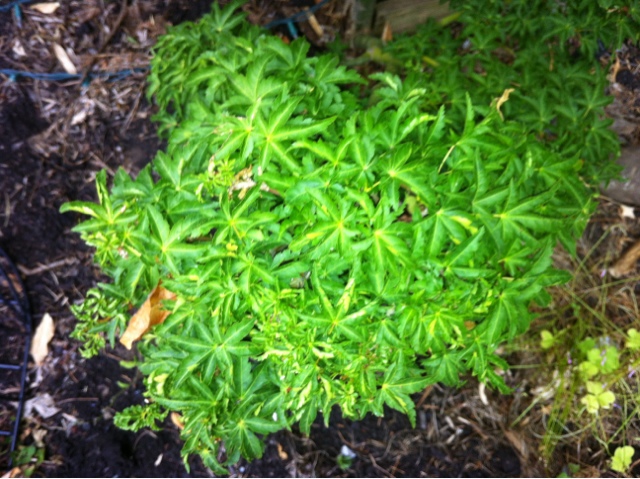
Shishishagira lionhead Japanese maple


Monday, July 29, 2013

Artemia Decapsulation

MATERIALS

Artemia Decapsulation

15 oz can of dried Artemia cysts (approximately 430 g) 4.3 L ~6% laundry grade bleach, chilled to 4oC
1.25 kg Rock Salt (NaCl)
125 ml 40% Lye (NaOH) solution (w/v)

30.0 g Sodium thiosulfate (Na2S2O3)
16 L Hatching Cone with aeration
125 um mesh bag (Aquatic Eco-Systems PMB3, 125 micron x 18") Several 3-5 L beakers
(1-2) Squirt bottles - squeeze type


SOLUTIONS


*Solutions should be prepared in advance - these need to be chilled to 4oC prior to use.
*Bleach, ~6% laundry grade
Chill a large bottle of bleach (need 4.3 L) in the refrigerator overnight at 4
oC.
*25 ppt Salt Solution
Combine: 50 g Rock Salt (NaCl)

To 2.0 L with tap water Stir to dissolve completely.
Refrigerate overnight at 4oC.
*40% Lye (NaOH) solution (w/v)
Combine: 200 g Lye (NaOH)

To 500 mL with tap water Stir to dissolve completely.
Store in refrigerator (4oC)
Buffered Salt Solution
Combine: 2L 25 ppt Salt Solution, prechilled to 4
oC
125 mL 40% Lye Solution, prechilled to 4oC
1.0% Sodium Thiosulfate
Combine: 30 g sodium thiosulfate

To 3.0 L with tap water
Stir to dissolve.
Saturated Brine
Combine: 1.2 kg Rock Salt

To 4.0 L with tap water
Stir to dissolve.


PROCEDURE


1. Cyst hydration: Hydrate one full can of dried cyst in 5 L of tap water in a hatching cone with aeration for 1 hour at room temp. Examine the cyst under a stereoscope with top lighting before proceeding. Dry cysts are dimpled, resembling a deflated basketball, whereas fully hydrated cysts are completely spherical in shape. The cysts must be fully hydrated prior to the decapsulation step. If cysts are not completely spherical after 1 hour, continue the hydration process (for a maximum of 2 hours), checking the progress of the cysts under a microscope every 15 min.

2. Filter and rinse cysts: Collect the hydrated cyst in a 125 um mesh bag and rinse with cool tap water. 

3. Transfer cysts back to the cone with the chilled Buffered Salt Solution and aerate (save back a filled squirt bottle of salt solution to help transfer cysts to cone).

4. Decapsulation: Add the chilled bleach (4.3 L) to the cone and continue aeration. Watch the cysts turn from brown to grey to orange, When the cysts are 90% orange, stop the reaction by quickly siphoning the cysts through a 125 um mesh bag and rinsing well with cool tap water.

5. Neutralization of residual chlorine: To neutralize any residual chlorine transfer the mesh bag to a clean 4 L beaker and pour the 1.0% Sodium Thiosulfate (3L) into the bag. Soak the cysts in the sodium thiosulfate solution for ~1 min, then rinse the cysts with dechlorinated tap water.

6. Dehydration for long-term storage: Transfer the cysts back to the cone with 4 L of saturated brine and aerate for 18-24 hours (save back a filled squirt bottle of saturated brine solution to help transfer cysts to cone). Add granular NaCl as needed to keep the solution saturated during the dehydration process. Transfer dehydrated cyst to (5 or 6) 1 L bottles and fill with fresh saturated brine. Store in refrigerator.