Total Pageviews

Thursday, July 4, 2013

Suzuki Baby Black Ranchu Moving Day 4th of July

They incubated for about a week in their bowls and are now moving to their newly constructed hatchery system.


Monday, July 1, 2013

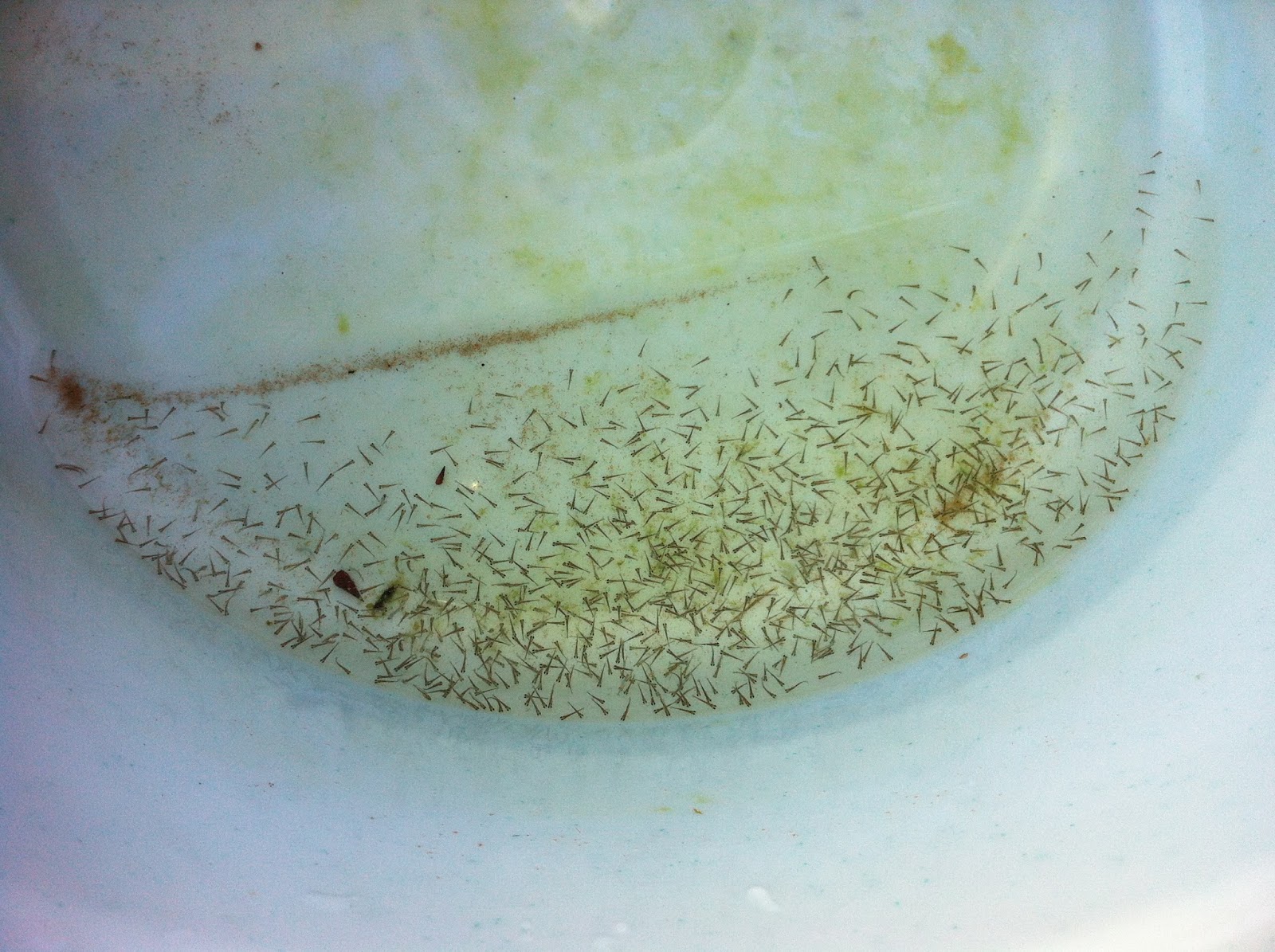
Kazuo Suzuki (KS) bloodline Ranchu Fry

Took a year and about $20K for this little tub of fry...

Friday, June 28, 2013

It's been a good week

Now the work begins. 

Troubling Times


Origin of Chinese Goldfish and Sequential Loss of Genetic Diversity Accompanies New Breeds


Origin of Chinese Goldfish and Sequential Loss of Genetic Diversity Accompanies New Breeds

Abstract

Background

Goldfish, Carassius auratus, have experienced strong anthropogenic selection during their evolutionary history, generating a tremendous extent of morphological variation relative to that in native Carassius. To locate the geographic origin of goldfish, we analyzed nucleotide sequences from part of the control region (CR) and the entire cytochrome b (Cytb) mitochondrial DNA genes for 234 goldfish and a large series of native specimens. Four important morphological characteristics used in goldfish taxonomy–body shape, dorsal fin, eye shape, and tailfin–were selected for hypothesis-testing to identify those that better correspond to evolutionary history.

Principal Finding

Haplotypes of goldfish rooted in two sublineages (C5 and C6), which contained the haplotypes of native C. a. auratus from southern China. Values of FST and Nm revealed a close relationship between goldfish and native C. a. auratus from the lower Yangtze River. An extraordinary, stepwise loss of genetic diversity was detected from native fish to goldfish and from Grass-goldfish relative to other breeds. Significantly negative results for the tests of Tajima’s D and Fu and Li’s D* and F* were identified in goldfish, including the Grass breed. The results identified eye-shape as being the least informative character for grouping goldfish with respect to their evolutionary history. Fisher’s exact test identified matrilineal constraints on domestication.

Conclusions

Chinese goldfish have a matrilineal origin from native southern Chinese C. a. auratus, especially the lineages from the lower Yangtze River. Anthropogenic selection of the nativeCarassius eliminated aesthetically unappealing goldfish and this action appeared to be responsible for the stepwise decrease in genetic diversity of domesticated goldfish, a process similar to that reported for the domestication of pigs, rice, and maize. The three-breed taxonomy–Grass-goldfish, Egg-goldfish, and Wen-goldfish–better reflected the history of domestication.


Goldfish and Lotus Netsuke


Topview Ranchu Japanese Import Group squeeze

First two fish are the females, then 4 males.  All crosses were made.

Obituary: Dr Joe Smartt

Copyright © Ray Rich
It is with great sadness that we inform you of the death of the goldfish expert Dr Joe Smartt.
Joe passed away peacefully at the Grange Nursing Home, Hedge End, Hampshire, on Friday June 7 in his 82nd year following a long illness which was stoically borne.
Joe was born in West Ham, London, on September 9th, 1931 and was educated at the nearby Forest Gate primary school. He gained degrees and qualifications at Durham, Cambridge and North Carolina Universities and, after working in Africa on a number of significant plant breeding programmes, he was offered a lectureship in genetics at Southampton University in 1967 and in 1990 he achieved the status of Reader in Biology.
Southampton University also honoured Joe by awarding him a DSC in 1989 for his work on the genetics and evolution of crop plants. In 1996, after 29 years of loyal service and distinguished research in evolutionary biology, Joe retired from the University.
Joe had a lifelong passion for all kinds of music and traditional  instruments, steam trains, goldfish breeding and judging, and folk dancing; he was the founder of the University's first Morris men troop, the Red Stags.
Joe was clearly a man of many parts and The Goldfish Society of Great Britain has been very fortunate in benefiting from his friendship and work on Goldfish genetics. He joined the Society in 1984 and began his regular contributions to the Bulletin, largely on Goldfish genetics, in 1986; stopping only 3-4 years ago when his health deteriorated.
He became the Society’s Scientific Adviser in 1988 and in acknowledgement of his work on Goldfish genetics he was awarded a Fellowship in 2000. He published two books on Goldfish genetics which, as far as I am aware, are the only books on Goldfish genetics written in English.
The books are "Goldfish Breeding and Genetics", written jointly with James (Jimmy) Bundell and "Goldfish Varieties and Genetics" which has "text book" status.
He was also a regular contributor to the Practical Fishkeeping magazine.
In 2006 he achieved the Society’s highest accolade by being appointed our President, which was followed by the award of Life Membership in 2009.
One of the World’s gentlemen, Dr Joe will be greatly missed by his family and friends throughout the world and in particular by his "goldfish friends" in the UK and the USA.
Our thoughts are with Joe’s wife Pam and his daughters Helena and Frances and his brother Tony at this sad time.
Published: John Parker Monday 24 June 2013, 10:53 pm
Views: 563 times
Filed under: obituary Joe Smartt goldfish expert genetics 
Wednesday, June 26, 2013

Wakin Spawn Japanese Imports

These were bred by a Wakin specialist in Japan. Happy to carry on his traditions in America. 

They are in greenwater, the eggs will incubate in greenwater and they fry will grow in greenwater eating daphnia. One more fish to picture but he jumped back in to the pond.